
The eastern and northern parts of Delhi witnessed rain and hailstorm, IMD said.

The southwest monsoon season concluded on Saturday with India receiving 'below-average' cumulative rainfall -- 820 mm compared to the long-period average of 868.6 mm -- in an El Nino year.

Heatwave conditions are expected over northwest India during the next five days, with Punjab, Haryana, Rajasthan and Delhi predicted to bear the maximum impact, the India Meteorological Department (IMD) said on Thursday.

Delhi recorded a cold wave for the second consecutive day on Friday, with the minimum temperature at Ayanagar in southwest Delhi plunging to a numbing 1.8 degrees Celsius.

After its late withdrawal from northwest India, the southwest monsoon remains active over some parts of the country.

The weather department attributed the unusual heat to the lack of rainfall due to the absence of active western disturbances over north India and any major system over south India.

The attack aimed to overthrow the democratically elected American government in order to replace it with a dictatorship fuelled by Nazi ideology, the Department of Justice said.

Scientists had earlier said the cyclone pulled the moisture and convection, impacting the intensity of the monsoon and delaying its onset over Kerala.

A one-day state mourning will be observed across India on Tuesday as a mark of respect for Iranian President Ebrahim Raisi, who died in a helicopter crash, the Union Home Ministry has announced.

Western disturbances are near Pakistan-Afghanistan and are moving towards Delhi and thunderstorms or dust storms are likely to be experienced in northwest India, senior scientist at IMD RK Jenamani told ANI.

'K Asifsaab was very definite that 'woh Hindustan ka honewala Badshah hai -- woh gana nahin gayega.'

"We are expecting that the temperature will be higher than normal in the entire northwest India and the adjoining central India, starting with Gujarat, Rajasthan and up to east Madhya Pradesh and Chhattisgarh," he said at a virtual event on 'Building Climate Resilience for the Most Heat Vulnerable'.
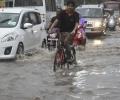
The southwest monsoon over the country is likely to be normal in July, the India Meteorological Department (IMD) said on Thursday in its forecast for the month.

In Delhi, Safdarjung, the base station for the national capital, recorded 44.2 degrees Celsius, while Mungeshpur observatory in northwest Delhi, reported 47.3 degrees Celsius.

Delhi's minimum temperature on Wednesday morning plunged to 4.4 degrees Celsius -- the season's lowest -- making the national capital colder than Dharamsala, Nainital and Dehradun.

The Battle of Lhagyala on November 23, 1962, fought by the 4 Rajput Regiment against the Chinese PLA, remains a forgotten chapter of heroism, with no survivors left to tell their story.

The mercury breached the 46-degree Celsius mark in several places such as Allahabad (46.8 degrees Celsius) and Jhansi (46.2 degrees Celsius) in Uttar Pradesh; Sports Complex (46.4 degrees Celsius) in Delhi; Ganganagar (46.4 degrees Celsius) in Rajasthan; Nowgong (46.2 degrees Celsius) in Madhya Pradesh; and Maharashtra's Chandrapur (46.4 degrees Celsius).

US Secretary of State Antony Blinken was asked by US Congressmen if the US had explore the possibility of northwest India for counter terrorism capabilities in Afghanistan. Blinken's remarks on India assume great importance, observes Ambassador M K Bhadrakumar

Large parts of north India reeled under numbing cold on Tuesday with the mercury remaining below freezing point at most places in Jammu and Kashmir, while dense fog in the early hours of the morning hit road and rail traffic movement.

According to an IMD forecast issued on Thursday, a heatwave spell will persist over northwest and central India during the next five days and over east India during the next three days.

The cold wave days in December too are expected to be 'below-normal' this year.

East and northeast India recorded 29 per cent rain deficit -- 141.5 mm against the normal of 199.9 mm -- from March 1 to May 3.

The Indian Navy's specialist team had protected them from nine armed pirates, and completed sanitization and seaworthiness checks of fishing vessel Al-Kambar.

Conditions were becoming favourable for further advance of the southwest monsoon over some more parts of the south peninsula and east India and adjoining areas between June 18 and 21.

There has been a sudden dip in temperatures in several parts of northwest India. Day temperature today in Delhi was 23 degrees Celsius against a normal of about 38 degrees Celsius, Met officials said.
KLM-Northwest Airlines reduces check-in time.

Several areas of Tamil Nadu remain inundated after hours of heavy to moderate rainfall in the region. Water entered houses and markets in the low-lying residential areas of Erode district due to heavy rainfall throughout the night.

The Met Office has issued a yellow alert, warning of moderate rain which could cause more problems to the residents of Delhi.
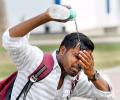
Heatwaves claimed more than 17,000 lives in 50 years in India, according to a paper authored by M Rajeevan, former secretary of Ministry of Earth Sciences, along with scientists Kamaljit Ray, S S Ray, R K Giri and A P Dimri.

Temperatures in March will be critical to determining the impact of any unusual heatwave conditions on this year's wheat crop in North India. It is that time of the year when the crop enters its vital grain-filling stage, say meteorologists and crop experts. So far, the high day temperatures in the North are not believed to have any significant impact on the final yields since the crop hasn't entered a stage where heat affects yields.

More than 150 express/passenger trains running through South Eastern Railway jurisdiction have been cancelled in view of the severe cyclonic storm, an SER official said.

'Usually the average rainfall per day is around 8 mm and India is receiving 10 to 11 mm per day since the last one week.' 'July seems to be very good for the entire country.'

Scores of people die every year due to cold waves that sweep across the north Indian plains.

The city's 24-hour Air Quality Index, recorded at 4 pm every day, stood at 418, up from 334 the previous day, and it may trigger stringent restrictions under the third stage of the graded response action plan to mitigate hazardous conditions.
Heatwave conditions have been prevailing in Odisha since April 15 and the Gangetic West Bengal since April 17, according to the MeT department.

Local officials said no casualties have been reported due to Wednesday's quake that hit the Madoi County in Golog Tibetan Autonomous Prefecture of Qinghai province of northwest China at 3:44 pm (Beijing time), tremors for which were also felt in north-eastern Nepal.

Close to half the country is experiencing deficient rains and the shortage for the figure has gone up to 16 per cent.

At the review meeting, chaired by cabinet secretary Rajiv Gauba in New Delhi, the IMD said above normal maximum temperatures are likely over most parts of northeast, east and central India and some parts of northwest India.

Several deaths were reported across the country due to rain-related incidents like lightning strikes and drowning.
